
xGen™ Hybridization Capture Core Reagents
Research reagents for the xGen NGS Hybridization Capture workflow
xGen Hybridization Capture Core Reagents enable reliable, high-quality targeted sequencing with a streamlined workflow and broad input compatibility. Combined with xGen Hybridization Panels, they support flexible, high-plex target enrichment optimized for a range of samples and timelines.
xGen NGS—made to maximize.
Ordering
- Deliver consistent, high-quality targeted NGS data across a wide dynamic range of input amounts (100 ng-6 µg) — without re-optimization
- Maintain uniform coverage and reliable capture performance as panel size, plexity, and sample complexity increase
- Generate targeted NGS data with a streamlined, easy-to-follow workflow that minimizes hands-on time and operator-dependent variability with no heated buffer handling and hybridization time as fast as 1hour
- xGen Universal Blockers effectively block diverse index adapter designs using proprietary sequence modifications to improve on-target performance
Transform Your NGS Workflow with Automation
Looking to streamline your NGS workflows? Discover how automation can enhance efficiency and consistency in your lab with our NGS Automation solutions.
For customers using the legacy xGen Lockdown reagents, these products can be ordered here.
For customers using the legacy xGen Hybridization and Wash Kit, these products can be ordered here.

Request a consultation
Your time is valuable, and we're here to help. Simply click the "Request a Consultation" button, provide some brief information about your project, and our experts will be in touch with you shortly.
Request a consultationProduct details
The xGen Hybridization and Wash v3 Kit is designed for use with xGen Hyb Panels and xGen Universal Blockers. This kit consists of two core components—the xGen Hybridization & Wash v3 Reagents and the xGen Hybridization & Wash v3 Beads—to perform the hybridization capture workflow. The latest version of the kit contains a new workflow and components that require no heated buffers or extra dilution steps of buffers to provide a complete, high-quality hybridization capture solution for targeted NGS research that you can complete in one day. The new buffer system allows for hybridization times as short as 1 hour and inputs as low as 100 ng.
Prevent adapter cross-hybridization by using xGen Universal Blockers in your hybridization capture reactions. Adapter sequences are ligated to all library fragments, both on-target and off-target, before enrichment. These adapter sequences can hybridize with each other during enrichment, creating a "daisy-chain" effect, with off-target fragments being captured alongside on-target fragments, which can impact sequencing efficiency.
xGen Universal Blockers bind to platform adapter sequences on a designated strand (usually the inverse of the synthetic adapter) to help prevent non-specific binding. Blocking the adapter sequences significantly improves capture results [1, 2].
Product data
One day hybridization
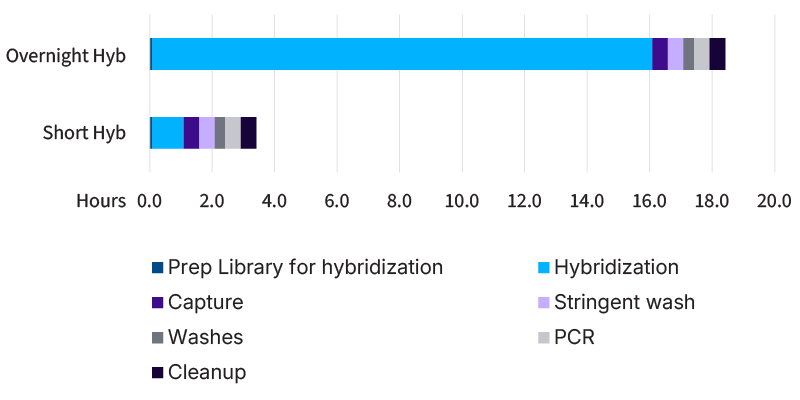
Figure 1. Complete hybridization capture in one day. Easy-to-follow targeted enrichment workflow that can easily fit into one day, along with library prep. xGen Hybridization and Wash v3 Kit can be completed in as little as 3.5 hours, so you can get more on the sequencer in less time.
Reduce hybridization capture time and maintain data quality
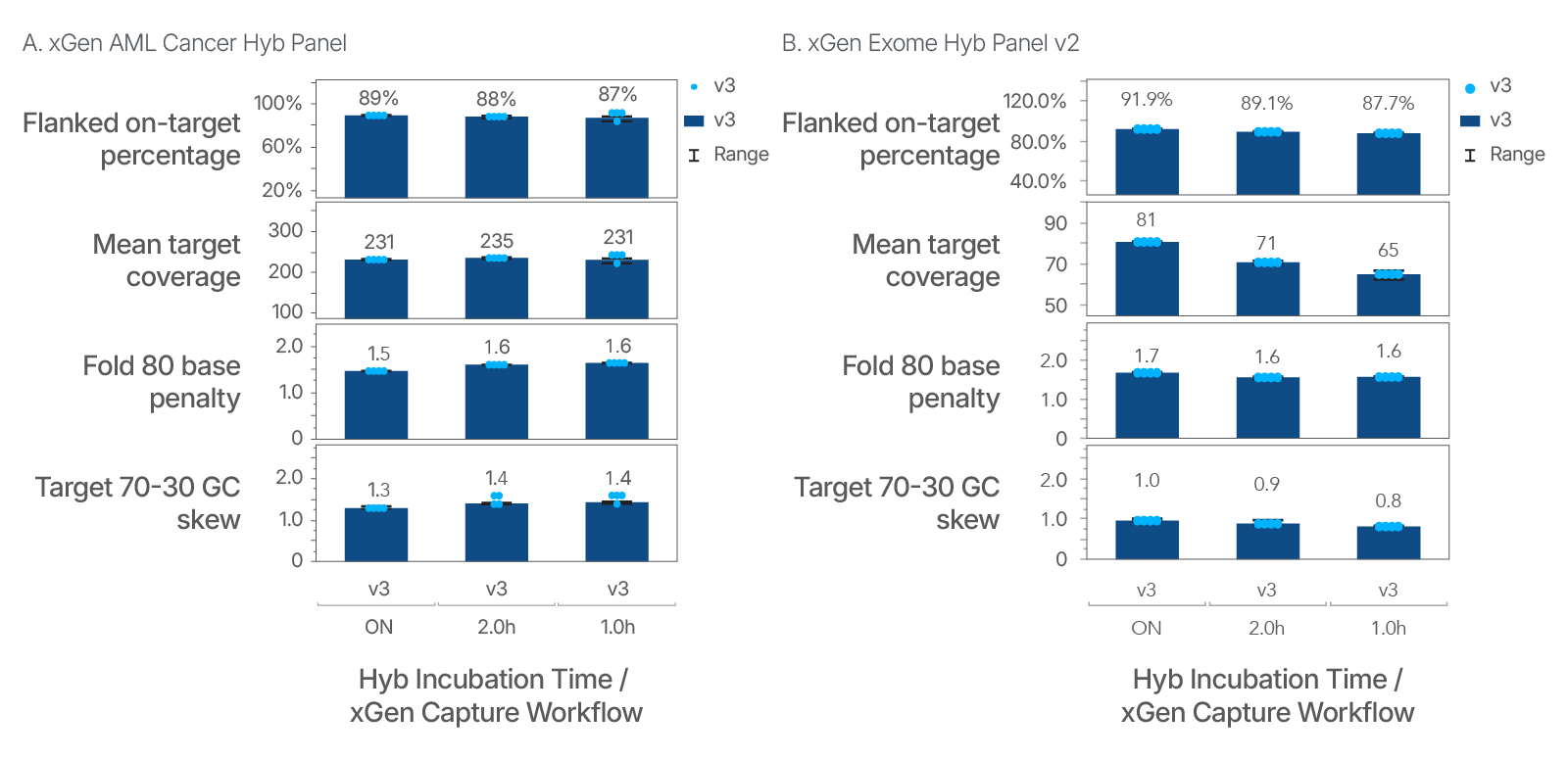
Figure 2. Reduce hybridization capture time and maintain data quality. To evaluate the performance of the new buffer system in xGen Hybridization and Wash Buffer v3, we set up a series of experiments to assess hybridization time with two different panels. The DNA libraries were prepared using xGen DNA EZ Library Prep kit with 25 ng Coriell gDNA NA12878. The DNA libraries were subsequently enriched using 400 ng of input with either the (A) xGen AML Cancer Hyb Panel or (B) xGen Exome Hyb Panel v2 for either overnight (ON), 2 hours, or 1 hour.
Captured libraries were sequenced on a NextSeq 2000 system (Illumina®) and subsampled to 5 M total reads per sample. A standard analysis pipeline was run to produce Picard metrics. The flanked-on target percentage and fold 80 base penalty was consistent for both panels between hybridization incubation times. (A) The mean target coverage and the GC skew were consistent for the xGen AML Cancer Panel. (B) A variation in the GC skew metric was observed between the different hybrization incubation times using the xGen Exome Hyb Panel v2.
Robust capture across a range of library inputs
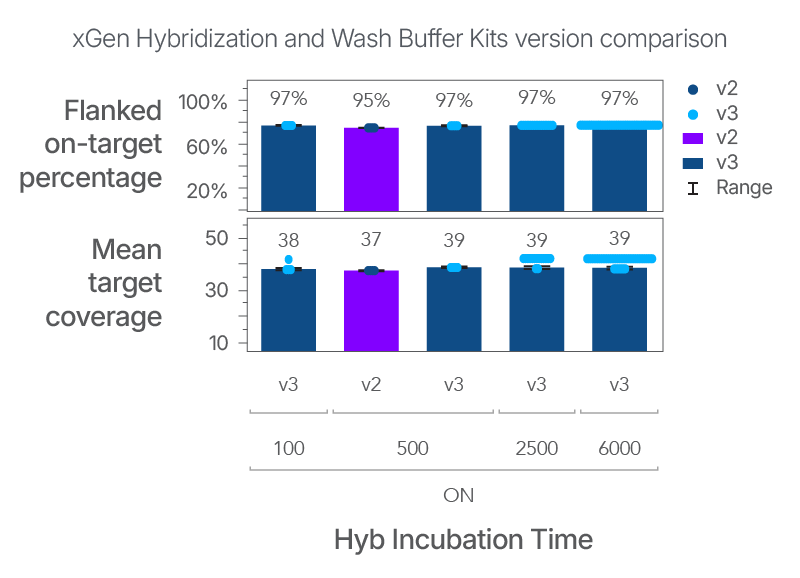
Figure 3. Consistent capture between xGen Hybridization and Wash Buffer v2 and v3 across a range of library inputs. To evaluate the performance of the v3 buffer system in xGen Hybridization and Wash Buffer v3 was compared to the xGen Hybridization and Wash Buffer v2 with different library inputs. The DNA libraries were prepared using the xGen cfDNA & FFPE DNA Library Prep v2 MC kit with 25 ng Coriell gDNA NA12878. The DNA libraries were subsequently enriched using 100 ng, 500 ng, 2500 ng, or 6000 ng of library input with the xGen Exome Hyb Panel v2 for overnight hybridization. Captured libraries were sequenced on a NextSeq 2000 system (Illumina®) and subsampled to 30 M total reads per sample. Standard analysis pipeline was run to produce Picard metrics. Despite the low sequencing data (30 M reads), the mean target coverage was consistent and robust across conditions.
Detect SNVs even in degraded sample types
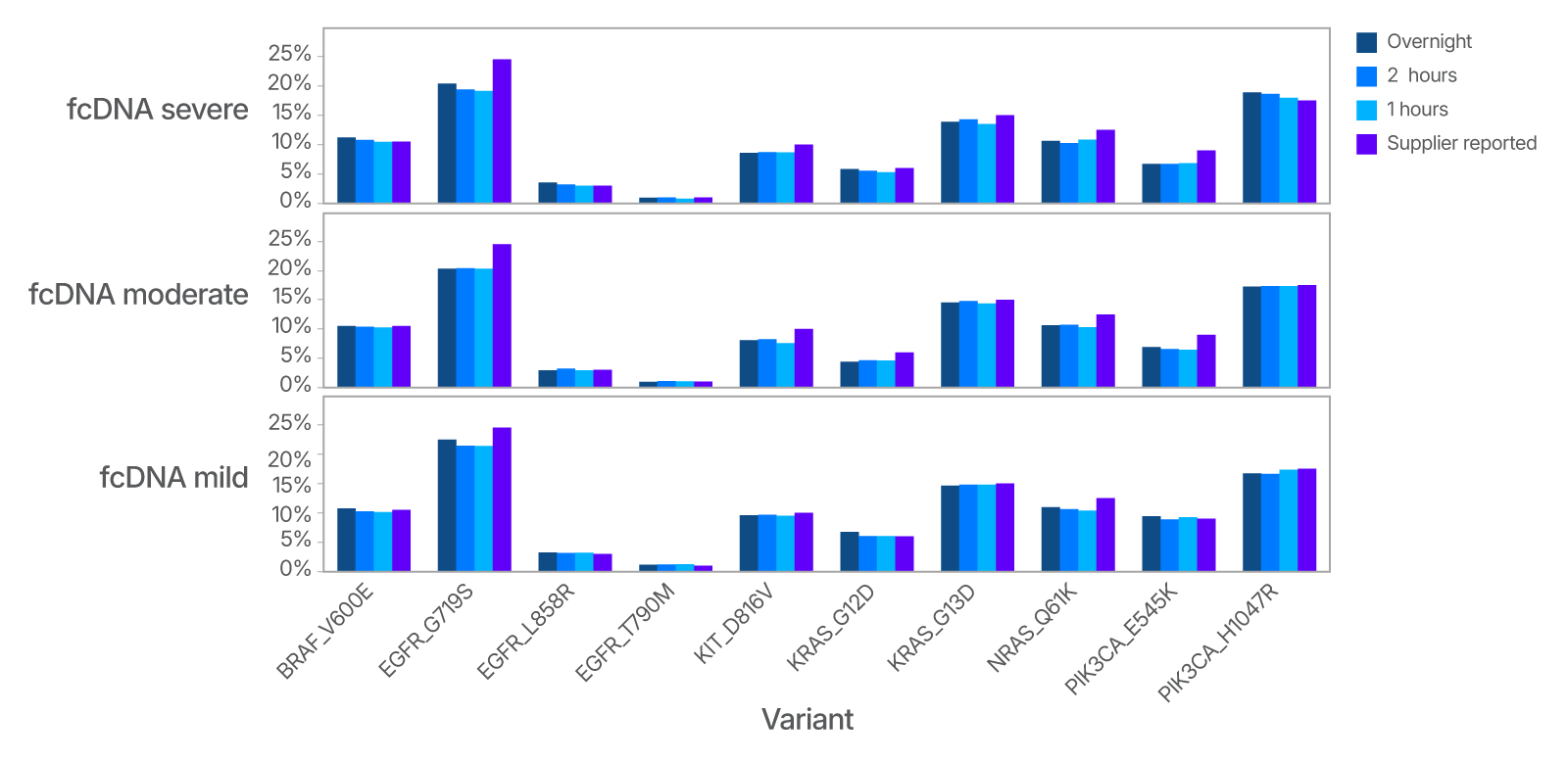
Figure 4. Impact of hybridization time on SNV detection in degraded samples. Three commercially available samples with known SNVs at measured frequencies, and with differing degrees of DNA damage (as measured by DIN score), were used as test library prep input. One hundred nanograms of DNA from each sample was used with the xGen cfDNA & FFPE DNA Library Prep Kit following IDT’s published protocol. Each sample was prepared in quadruplicate. Five hundred nanograms of library was used in a singleplex capture for various times of hybridization (overnight, 2 hours, and 1 hour). Samples were sequenced to approximately 100 M total reads and analyzed, to create ssConsensus data that was interpreted by VARDICT. The measured allele frequency for each of the known SNVs is indicated for different hybridization times. The following samples were used: Horizon discovery standards - HD803 (fcDNA severe), HD799 (fcDNA moderate), and HD798 (fcDNA mild).
Increase on-target rates by using xGen Universal Blockers
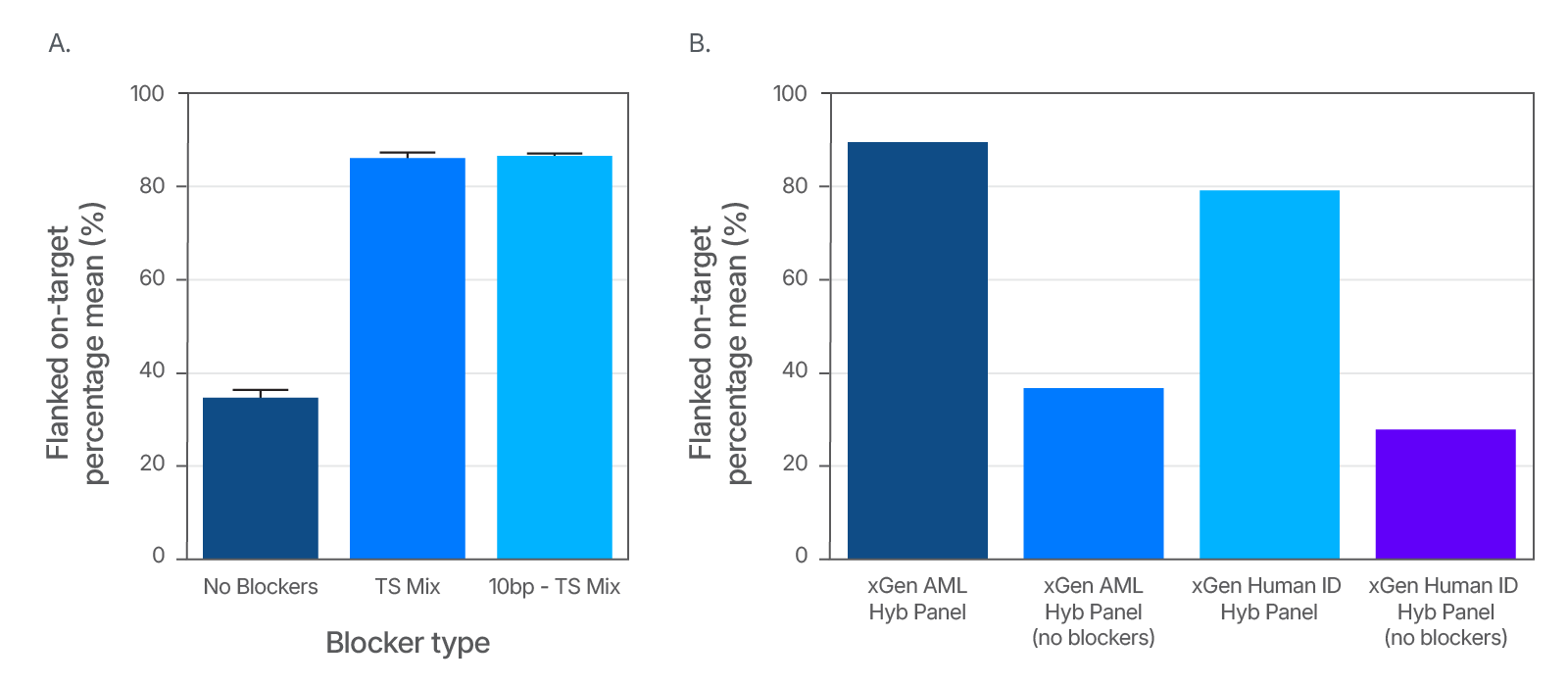
Figure 5. An example of improved on-target rate delivered by xGen Universal Blockers across Illumina TruSeq® (A) and Illumina Nextera® (B) adapter styles. (A) 1 µg input DNA libraries were prepared from human genomic cell line NA12878 (Coriell) using either 8 nt or 10 nt adapters and enriched using the xGen AML Cancer Hyb Panel (single-plex, n = 3 for each condition) with xGen™ Universal Blockers TS, xGen™ Universal Blockers 10bp TS, or without blockers. Sequencing was performed on a NextSeq 500 System (Illumina) to generate 2x150 bp paired-end reads. (B) 50 ng cell line NA12878 (Coriell) gDNA was used for Nextera library preparation. Amplified libraries were enriched in 4-plex reactions (n = 3) using the xGen AML Cancer Hyb Panel, or in 12-plex (n = 1) using the xGen Human ID Hyb Panel, with xGen Universal Blockers NXT or without blockers (n = 1). Sequencing was performed on a NextSeq System (Illumina) to generate 2x75 bp paired-end reads. Libraries and captures from both figures were amplified using KAPA 2X HiFi PCR Mix, as this data was generated prior to release of xGen 2X HiFi PCR Mix.
High on-target and uniform coverage with xGen Universal Blockers 10bp TS
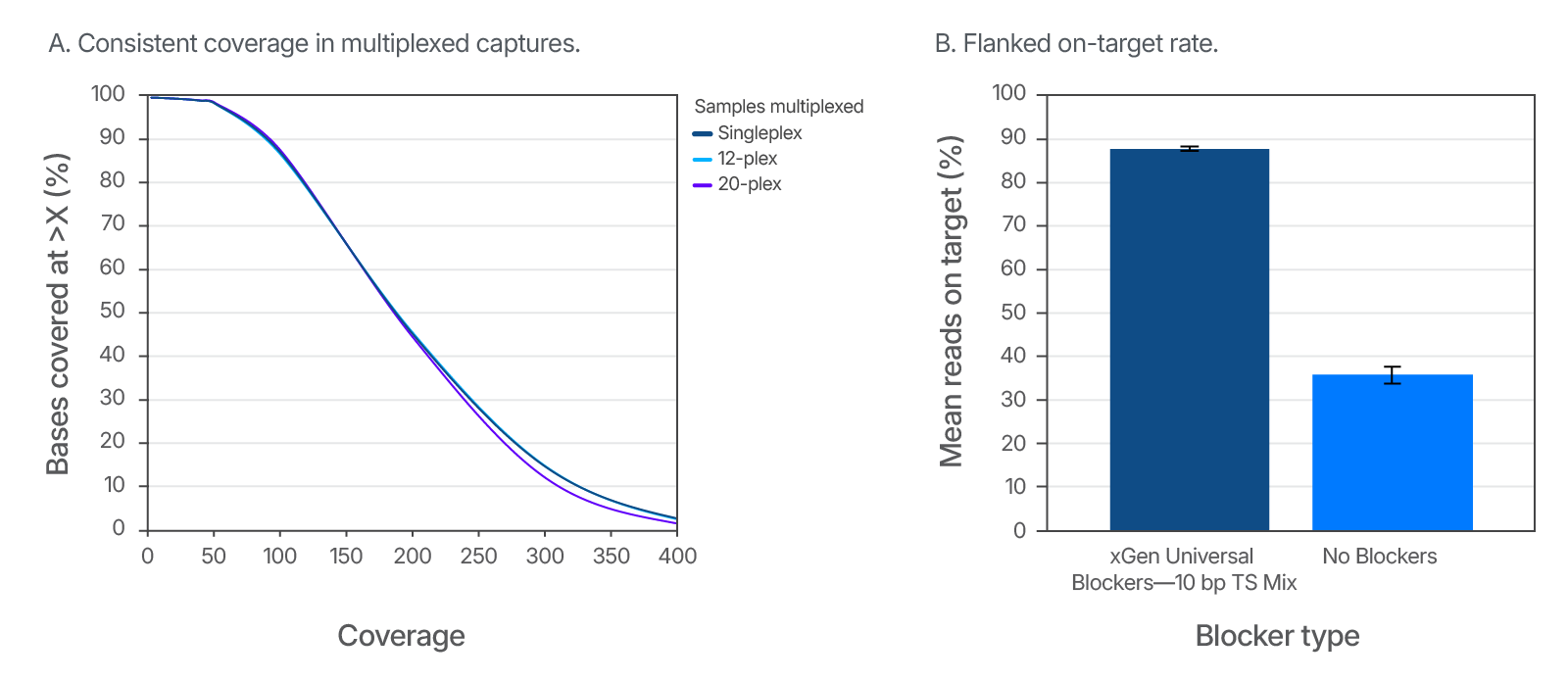
Figure 6. Consistent coverage in multiplexed captures and improved on-target rates with the addition of xGen Universal Blockers. (A) Example of consistent results with multiplexed samples using the xGen Universal Blockers 10bp TS. DNA libraries (500 ng input per sample) from cell line NA12878 (Coriell) were enriched in single (n = 8) or multiplex reactions (n = 3) using the xGen AML Cancer Hyb Panel. The libraries were created using 10 bp TruSeq adapters with unique dual indexes. Sequencing was performed on a NextSeq 500 System (Illumina) with 2x150 bp paired-end reads. Coverage was consistent across all multiplexing levels tested. (B) Example of improved on-target rates delivered by xGen Universal Blockers 10bp TS. DNA libraries (500 ng input per sample) from cell line NA12878 were enriched in single-plex reactions (n = 3) using the xGen AML Cancer Hyb Panel with and without xGen Universal Blockers 10bp TS. Sequencing was performed on a NextSeq 500 System to generate 2x150 bp paired-end reads. On-target values (with 150 bp flank) were averaged across experiments. Libraries and captures from both figures were amplified using KAPA 2X HiFi PCR Mix, as this data was generated prior to release of xGen 2X HiFi PCR Mix.
Resources
Protocols
Flyers
Posters


- Direct comparison of single-stranded vs. double-stranded probe panels for NGS target enrichment by hybridization capture
- Demonstration of increased workflow flexibility and efficiency for novel hybridization capture approach
- Tunable hybridization capture allows for modulation of GC coverage via simple adjustments in post-capture washes
- Impact of DNA fragment size on targeted sequencing using hybridization capture
- New streamlined hybridization-capture enables flexible inputs and hybridization times without hot liquid handling
- Introducing new technology for high performance whole exome sequencing with unparalleled hybridization time flexibility and capability for low to high capture-input
- Panel-adjustable and user-friendly hybridization-capture technology delivers high performance demonstrated by different exome probe panels
- Novel and user-friendly hybridization capture workflow for low quality samples on small gene panels
Safety data sheets
Certificates of analysis (COAs)
Frequently asked questions
Is the xGen™ Pre-hybridization Normalase™ Module compatible with the xGen Hybridization and Wash v3 Kit?
The xGen™ Pre-hybridization Normalase module can be used upstream of hybridization capture to normalize library inputs prior to enrichment. This workflow was demonstrated with various input amounts and sample preparation approaches supporting integration with upstream normalization steps for both singleplex and multiplex hybridization experiments. As with all workflows, users should follow recommended input guidelines and validate performance within their specific application.
Can I multiplex libraries into a single hybrid capture when using the xGen™ Hybridization and Wash v3 Kit?
The xGen™ Hybridization and Wash v3 workflow has been verified to support both singleplex and multiplex samples, including configurations up to 12-plex (up to 6000 ng total input). The workflow’s flexibility across input amounts (100 ng to 6000 ng) and compatibility with different experimental setups enables users to confidently scale from single sample to multiplex experiments. For best results, ensure unique sample indexing and appropriate sequencing depth for the level of multiplexing used.
Do I need to prepare the buffers in any way before performing captures with the xGen™ Hybridization and Wash v3 Kit?
For the xGen™ Hybridization and Wash v3 workflow, reagents should be allowed to equilibrate to room temperature before use. No high temperature preheating steps are needed reflecting a streamlined design of the workflow which eliminates the need for pre-heated buffers and hot liquid handling.
What do I do if I get variable results between replicate captures when using the xGen™ Hybridization and Wash v3 Kit?
If variability is observed, consider the following factors:
1. Mixing and handling: ensure thorough and consistent mixing of capture reactions to maintain homogeneity throughout the workflow. Thorough mixing is vital for consistent results.
2. Input consistency: verify that library input amounts are within the recommended range (100 – 6000ng total) and are evenly distributed across replicates
3. Library quality: differences in DNA quality may contribute to variability, although this workflow has been shown to perform robustly across challenging sample types
4. Sequencing depth: ensure sufficient and consistent sequencing depth across samples, particularly when multiplexing
5. General workflow consistency: maintain consistent timing, mixing, preparations steps
Can I use my old xGen™ panels that were used with the xGen Hybridization and Wash v2 Kit with the v3 Kit?
Yes, xGen Hybridization and Wash Buffer v3 Kit is designed to work with any standard xGen panels, stocked or custom.
Can I spike in panels when using xGen™ Hybridization and Wash kit v3?
Yes, the instructions on how to spike in can be found in the protocol appendix.
What if I don’t have a Speed Vac to dry down libraries needed for the xGen™ Hybridization and Wash v3 Kit?
Please refer to Appendix A of the xGen Hybridization and Wash v3 Kit protocol for the AMPure XP Bead DNA concentration method. A user can also consider an oven/incubator at 65°C for a few hours.
Are there safe stopping points with the xGen™ Hybridization and Wash v3 Kit protocol like the previous versions?
Defined stopping points are specified in the xGen™ Hybridization and Wash Reagents v3 Kit protocol. Users should follow the protocol guidance for any recommended pauses.
When using the xGen™ Hybridization and Wash v3 Kit, can I hybridize with a thermocycler lid temperature below 105°C?
Yes. We recommend setting thermocycler lid at least 10°C above the sample temperature for all heated steps.
When using the xGen™ Hybridization and Wash v3 Kit, can I hybridize at 65°C instead of 70°C?
Hybridization should follow the temperature specified in the protocol. Any changes should be evaluated for your specific application.
Can I substitute buffers or reagents from versions 1 and 2 with version 3 of the xGen™ Hybridization and Wash Kit?
No. Version 3 has different formulations for the buffers than previous versions. Only the xGen Bead Wash buffer is the same as the previous versions. The protocol versions are also not interchangeable.
What is the impact on performance if only using 100 ng of library input with the xGen™ Hybridization and Wash v3 Kit?
Using 100 ng of library input is supported with the xGen™ Hybridization and Wash v3 Kit workflow and has been shown to produce comparable targeting performance under many conditions. However, some differences may be observed such as coverage depth, yield, and library complexity. Effects may be more noticeable with short hybridization times or highly multiplexed samples.
I switched to xGen™ Hybridization and Wash v3 Kit and noticed a shift in my GC read distribution. Is this normal?
xGen Hybridization Wash v3 Kit will produce an improved AT/GC balance to better reflect the probe panel design and library input content. The buffer compositions have changed to minimize bias from hybridization, capture, and wash. Therefore, most users who switch from v1 & v2 to v3 may observe an increase in AT content relative to the GC content.
The post-capture AT vs. GC content is largely dictated by the input library and the panel. Therefore, the resulting GC content would be a combination of the interactions between the library, the panel, the workflow, and the post-capture amplification mix.
Does xGen™ Hybridization and Wash v3 Kit performance benefit from longer hybridization incubation?
Longer hybridization incubation would result in less variability, higher on-target, and higher post-capture library diversity. Increasing from 1-hour to 2-hour hybridization can yield significant positive differences. The impact on results will stem from the library, capture panel, and their interactions.
Our lab uses non-IDT library preps that worked well with xGen™ Hybridization and Wash v1 and v2 Kits. Can we use the xGen Hybridization and Wash v3 Kit for these libraries?
The new kit is compatible with libraries that worked with xGen Hybridization and Wash v1 and v2 Kits.
What types of libraries can be used with xGen™ Hybridization and Wash v3 Kit?
Users can expect libraries that were used with previous versions to be enriched with version 3 of the kit. We recommend libraries generated with xGen library preparation kits such as:
- xGen cfDNA and FFPE DNA Library Prep Kit
- xGen DNA Library Prep Kit EZ & EZ UNI
- xGen DNA Library prep MC & MC UNI
- xGen RNA and Broad Range Kit
What are the buffer storage conditions for the xGen™ Hybridization and Wash v3 Kit?
Storage conditions depend on the reagent type and buffers should be handled according to protocol labels and recommendation. Wash buffers and beads can be stored at 4°C for up to 10 weeks. Reagents should be equilibrated to room temperature before use.
What are some of the considerations with a short hybridization time?
Short hybridization times (e.g., 1-2 hours) are supported and can deliver comparable targeting performance under many conditions, but some trade-offs should be considered. The following considerations may apply:
1. Coverage and yield: shorter hybridization may result in slightly lower capture yield or coverage depth, particularly with low input.
2. Input dependence: higher total inputs with shorter hybridization times may show minor differences in metrics such as GC skew or yield under some conditions.
3. Panel design effects: performance with short hybridization can depend on panel size and probe design as coverage behavior reflects panel characteristics rather than workflow bias.
4. Application needs: for applications requiring maximum uniformity or depth, longer hybridization times may still be preferred.
What is new about version 3 of the xGen™ Hybridization and Wash Kit?
Version 3 can be used in the same manner as previous versions of the xGen™ Hybridization and Wash kits. IDT has optimized the buffers to reduce the overall number of washing steps and ease the workflow. Customers are not required to change their xGen™ capture panels or libraries than previously used.
We also introduce an optional short hybridization period of only 1 hour. Customers can still use the standard 4- or 16-hour incubations. We recommend users empirically test the shorter hybridization time for their workflows.
We have also lowered the supported input for hybridization capture to 100 ng of library instead of 500 ng. We recommend users empirically test the lower input amount for their workflow.
References
- Blumenstiel B, Cibulskis K, et al. Targeted exon sequencing by in-solution hybrid selection. Curr Protoc Hum Genet. 2010;Chapter 18:Unit 18.4.
- Hodges E, Rooks M, et al. Hybrid selection of discrete genomic intervals on custom-designed microarrays for massively parallel sequencing. Nat Protoc. 2009;4(6):960-974.
TruSeq® and Nextera® are registered trademarks of Illumina, Inc., and used with permission. All rights reserved.